
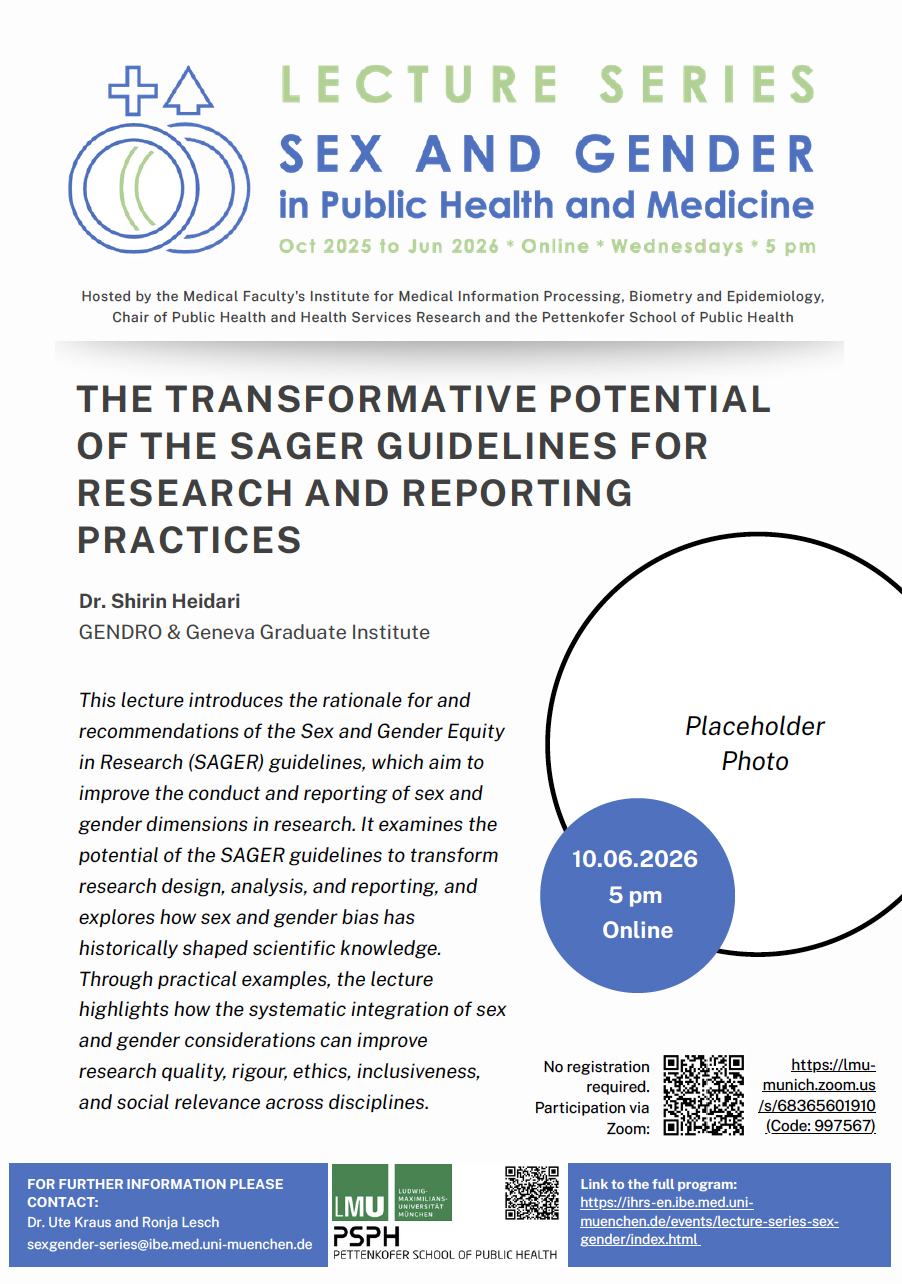
10 June 2026 | Organizer: Pettenkofer School of Public Health
ABOUT THE PRESENTER
Dr Shirin Heidari is the Founder and Executive Director of GENDRO, a Geneva-based international non-profit association dedicated to addressing gender bias in research and data. She is the lead author of the widely adopted Sex and Gender Equity in Research (SAGER) guidelines, a key instrument for closing gender evidence gaps. Through GENDRO, she provides technical support to research organisations and global health bodies, including the World Health Organization, to strengthen the integration of sex and gender dimensions in health research, policy, and programming.
She is also Principal Investigator of the Liminality Research Consortium at the Gender Centre, Geneva Graduate Institute, where she leads a collaborative multi-country project on sexual and reproductive health and rights in forced displacement, grounded in an intersectional feminist approach.
Previously, Dr Heidari served as Executive Director of Sexual and Reproductive Health Matters and Editor-in-Chief of its journal. At the International AIDS Society, she led the Research Promotion Department, advancing pioneering initiatives on women’s health, including a consensus research agenda on HIV and women, and served as Editor of the Journal of the International AIDS Society.
She holds a PhD in clinical virology and experimental oncology from Karolinska Institute (2001) and has worked across research, policy, and advocacy in non-profit organisations, academia, and UN agencies. She has served as Board Member of Amnesty International Sweden, Council member of the European Association of Science Editors and founding chair of its Gender Policy Committee, member of the Impact Committee of the Human Immunome Project and Commissioner on the Lancet Commission on Women, Power, and Cancer. She currently serves as Co–Vice President of the Foundation Board of the Geneva International Film Festival and Forum on Human Rights.
A TEDx speaker and author of numerous publications, Dr Heidari was recognised in 2022 as one of twelve influential figures shaping the future of International Geneva. Her work was profiled in Cell in 2024, and The Lancet in 2025.